
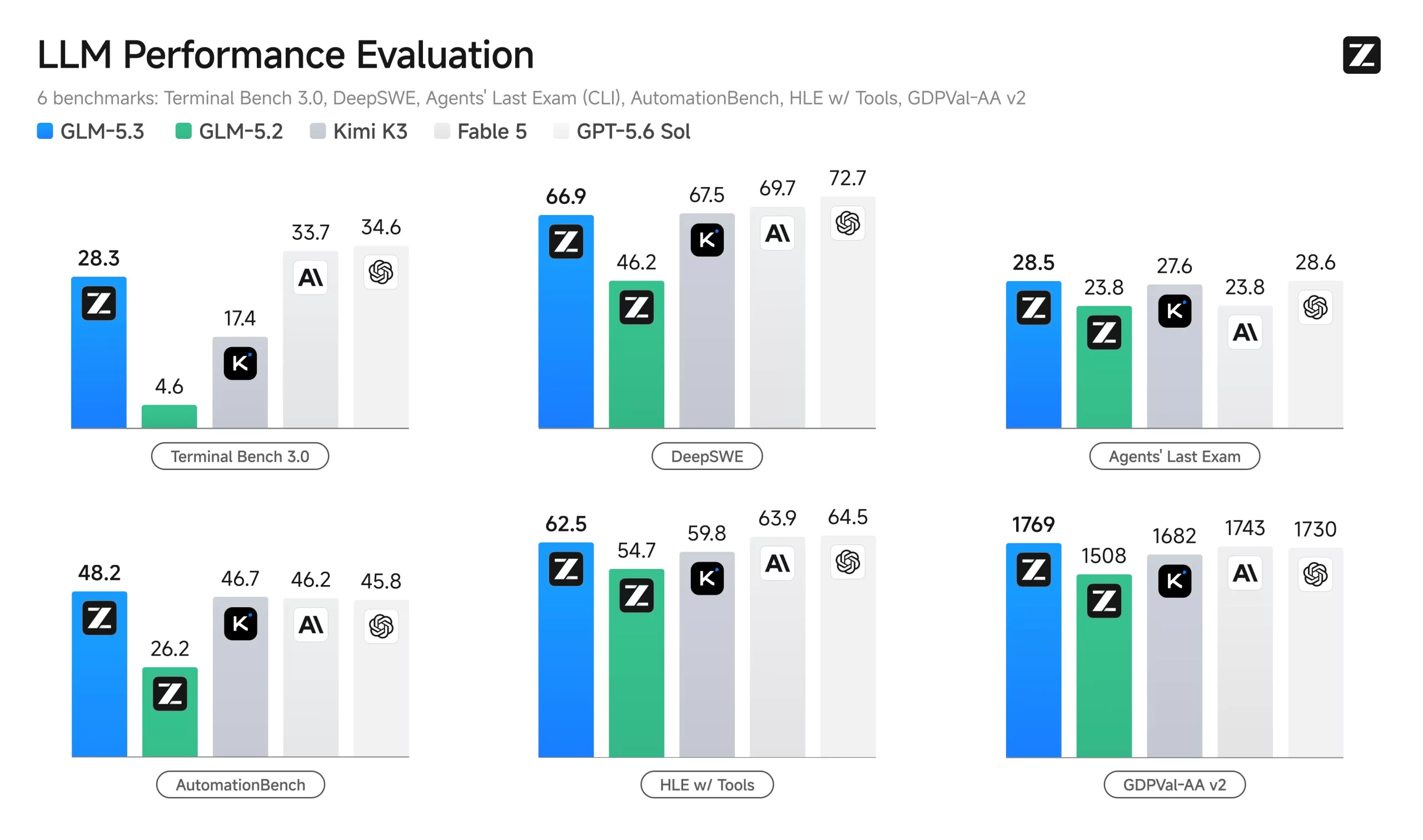
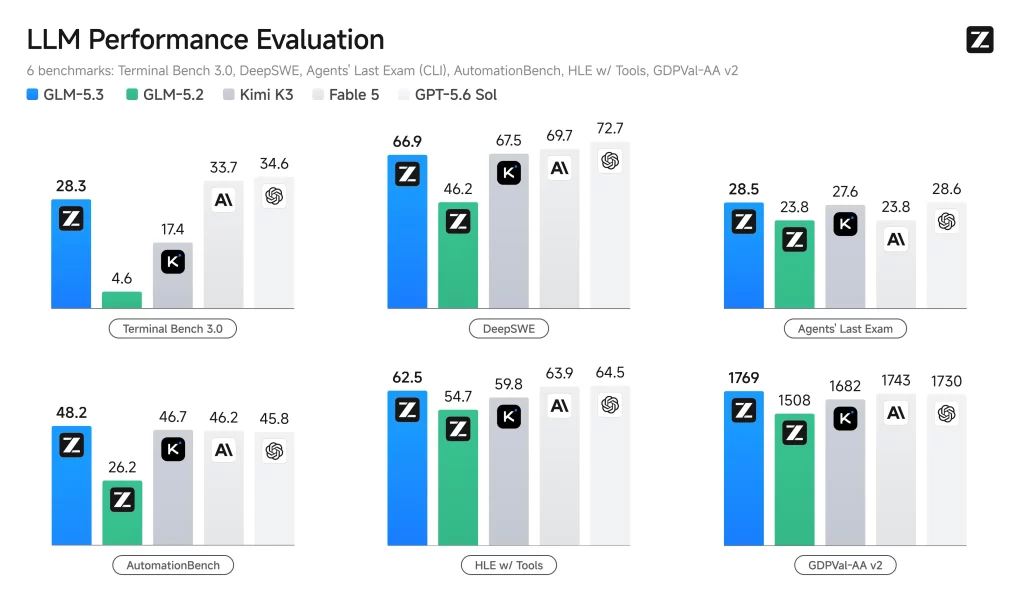
Performance across comparison models
| Benchmark | GLM-5.3 | GLM-5.2 | Kimi K3 | DeepSeek-V4Pro-0813 | Qwen3.8-Max | Opus 4.8 | Fable 5(w/ fallback) | GPT-5.6 Sol |
|---|---|---|---|---|---|---|---|---|
| Coding | ||||||||
| Terminal Bench 2.1 | 88.2 | 81.0 | 88.3 | 87.9 | 86.6 | 85.0 | 88.0 | 88.8 |
| Terminal Bench 3.0 | 28.3 | 4.6 | 17.4 | – | – | 21.1 | 33.7 | 34.6 |
| DeepSWEv1.1 | 66.9 | 46.2 | 67.5 | 62.7 | 56.6 | 58.0 | 69.7 | 72.7 |
| NL2Repo | 58.0 | 48.9 | 58.0 | 61.1 | 55.9 | 69.7 | – | – |
| ProgramBenchAlmost Solved | 19.0 | 9.5 | 17.5 | – | 10.5 | 15.5 | 33.0 | 23.0 |
| FrontierSWE | 78.1 | 67.5 | – | – | – | 66.5 | 88.2 | – |
| SWE-Marathonv1.1 | 42.5 | 19.4 | 48.1 | – | – | 48.8 | 33.1 | 42.5 |
| PostTrainBench | 39.8 | 31.7 | 32.0 | – | – | 32.9 | 41.8 | 36.2 |
| Cyber | ||||||||
| CyberGym | 84.5 | 77.2 | 80.0 | 83.3 | 78.5 | 78.1 | 83.8 | 83.6 |
| ExploitGym2h / 6h | 105 / 130 | 29 / 39 | 36 / 70 | – | 14 / 26 | 80 / 120 | 181 / 247 | 216 / 293 |
| ExploitBench | 54.4 | 24.4 | 32.2 | – | 28.8 | 40.0 | 78.0 | 76.5 |
| Agentic | ||||||||
| Toolathlon Verified | 73.0 | 59.9 | 76.5 | 74.1 | 72.5 | 76.2 | 74.7 | 74.9 |
| AutomationBenchv1.0.6 | 48.2 | 26.2 | 46.7 | 43.2 | 39.8 | 41.0 | 46.2 | 45.8 |
| Agents’ Last ExamALE-CLI | 28.5 | 23.8 | 27.6 | 25.7 | 27.0 | 25.7 | 23.8 | 28.6 |
| HLE w/ Tools | 62.5 | 54.7 | 59.8 | 60.0 | 56.2 | 57.9 | 63.9 | 64.5 |
| GDPval-AA v2 | 1769 | 1508 | 1682 | 1590 | 1739 | 1588 | 1743 | 1730 |

On August 14, 2026, Z.ai officially released GLM-5.3.👉 https://z.ai/subscribe?ic=Y2H91IWSU3
This is not a routine incremental update. The first sentence of the official blog post sets the tone:
“Scaling post-training is all we did for GLM-5.3.”
In other words: we changed nothing about the base model. We simply scaled post-training to the limit.
The results are staggering — the exact same base model delivers a 6x improvement in coding benchmarks, unexpectedly emergent cybersecurity capabilities, and performance that rivals or surpasses closed-source giants on long-horizon tasks.
I. The Most Counterintuitive Finding: Same Foundation, Leapfrog Gains
GLM-5.3 shares the identical base model with GLM-5.2. Every single improvement comes from 100% post-training scaling.
What does this mean?
In the LLM field, we’ve grown accustomed to the “scale is all you need” narrative: bigger models, more parameters, longer pre-training. But GLM-5.3 sends a fundamentally different signal — when base model quality crosses a certain threshold, post-training scaling may yield higher marginal returns than pre-training.
Over the past month, Z.ai doubled down on their existing stack:
- IndexShare: Efficient long-context processing
- SAO (Self-Adaptive Optimization) with compaction: RL for long-horizon tasks
- slime: Large-scale asynchronous training framework
- And most critically — massive accumulation and synthesis of real-world workflow environments
II. Coding: From “Can Do” to “Can Own”
If GLM-5.2 was a “coding assistant,” GLM-5.3 is evolving into an “engineering agent” capable of owning substantial tasks end-to-end.
The Numbers Don’t Lie
表格
| Benchmark | GLM-5.3 | GLM-5.2 | Improvement |
|---|---|---|---|
| Terminal Bench 3.0 | 28.3 | 4.6 | 6.1x |
| DeepSWE v1.1 | 66.9 | 46.2 | 1.4x |
| Agents’ Last Exam | 28.5 | 23.8 | 1.2x |
| AutomationBench | 48.2 | 26.2 | 1.8x |
The 6x jump on Terminal Bench 3.0 is the most eye-catching. This benchmark tests a model’s ability to perform complex operations in real terminal environments — not just writing a function, but understanding context, executing commands, debugging errors, and completing multi-step tasks within a full development environment.
Going from 4.6 to 28.3 means GLM-5.3 crossed the threshold from “can barely do it” to “can reliably complete it.”
Z.ai Code Bench: A More Realistic Test
Z.ai also revealed internal Z.ai Code Bench results — GLM-5.3 improved 50% over 5.2.
What makes this benchmark special is that it wasn’t designed to game leaderboards. It simulates real user scenarios: complex local development environments, diverse task categories, and engineering work that needs to be completed end-to-end. Some tasks take experienced engineers several days.
More importantly, Z.ai Code Bench is a private benchmark, which eliminates the risk of models overfitting to public test sets and provides a more faithful measure of real-world user experience.
III. Emergent Cybersecurity: The Unexpected Side Effect
If the coding improvements were expected, the emergent cybersecurity capabilities came as a complete surprise.
Z.ai candidly admits in the blog:
“As we scaled post-training, cyber capability developed faster than we expected.”
Vulnerability Discovery: CyberGym SOTA
On the CyberGym vulnerability discovery benchmark, GLM-5.3 scored 84.5, surpassing all comparison models including GPT-5.6 Sol (83.6) and Fable 5 (83.8) to claim SOTA.
Exploitation: More Than Doubled
Even more astonishing is the performance on exploitation chains:
表格
| Test | GLM-5.3 | GLM-5.2 | Improvement |
|---|---|---|---|
| ExploitGym (2h) | 105 | 29 | 3.6x |
| ExploitGym (6h) | 130 | 39 | 3.3x |
| ExploitBench | 54.4 | 24.4 | 2.2x |
Z.ai specifically notes that the further up the exploitation chain, the larger GLM-5.3’s advantage becomes. This means the model doesn’t just find vulnerabilities — it can autonomously construct complete attack chains. This was unthinkable just two months ago.
The significance of this discovery extends far beyond a benchmark score. It hints at a possibility: when post-training environments are rich enough and tasks are realistic enough, models may spontaneously develop capabilities that designers never anticipated.
IV. How They Did It: Environment Is Everything
GLM-5.3’s technical approach can be summarized in one sentence: make post-training environments sufficiently realistic, then scale.
From Handcrafted to Auto-Synthesized
Early RLHF/RL environments were typically handcrafted — limited in number and simplistic in scope. But Z.ai realized that as agent capabilities improve, the bottleneck shifts from the model to the environment.
An effective training environment must satisfy three conditions:
- Executable — runs in a real environment
- Verifiable — has clear correctness criteria
- Close to real work — not toy problems, but tasks engineers face daily
To scale this process, Z.ai built an end-to-end environment synthesis pipeline:
- Research agents collect task patterns from real work
- Convert them into runnable long-horizon environments with multi-step dependencies and hidden state
- Judge agents attempt each task to verify solvability
- Verifiers are synthesized without access to reference solutions, passing oracle, no-op, and unsolved-state checks
- Reward shortcuts are discovered and closed, ensuring reliable reward signals
SAO with Compaction: The Secret to Long-Horizon Tasks
GLM-5.3 inherits the SAO strategy from GLM-5.2, with the addition of a compaction mechanism.
The core idea: in long-horizon tasks, the volume of information is enormous. Without compression, the context window fills up quickly. The compaction mechanism allows the model to actively compress and organize intermediate states, focusing attention on information that genuinely affects task progress.
The effect is visible in the data — GLM-5.3’s improvements hold not just on short tasks, but on long-horizon tasks as well. This suggests the model learned how to learn, rather than simply memorizing more patterns.
V. Open Source & Pricing: See You in Two Weeks
Z.ai has committed to releasing GLM-5.3’s weights two weeks after launch, pending safety evaluation and hardening.
This continues Z.ai’s consistent open-source strategy. At a time when closed-source models are growing ever stronger and the open-source community has shown signs of fatigue, GLM-5.3 is a shot of adrenaline — it proves that open-weight models can still compete at the top level, and even lead in certain domains.
Pricing & Ecosystem
The Z.ai GLM Coding Plan starts at $18/month, with full support for Claude Code, Cline, and 20+ top coding tools.
If you’re considering subscribing, you can use my exclusive referral link for a 10% discount:
👉 https://z.ai/subscribe?ic=Y2H91IWSU3
VI. Final Thoughts: A New Paradigm for Post-Training
The most important lesson from GLM-5.3 isn’t any specific score. It’s the validation of a hypothesis:
When the base model is good enough, post-training scaling can independently drive qualitative capability leaps.
This changes how we think about LLM development. We used to believe that improving model capability depended on three things: bigger models, more data, longer pre-training. But GLM-5.3 tells us that a fourth factor may be equally important — better environments, more realistic tasks, and smarter training strategies.
In a sense, GLM-5.3 isn’t training a better language model. It’s training a better digital employee — an agent that can understand context, decompose tasks, execute operations, and verify results in real work environments.
The weights drop in two weeks. I can’t wait to see what the community builds with them.
了解 码奋 的更多信息
订阅后即可通过电子邮件收到最新文章。